Congo Red
Name: Congo Red
CAS Registry Number: 573-58-0
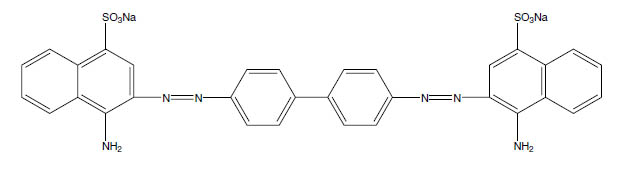
CA Index Name: 1-Naphthalenesulfonic acid, 3,3'-[[1,1'-biphenyl]-4,4'-diylbis(2,1-diazenediyl)]bis[4-amino-, sodium salt (1:2)
Other Names: 3,3'-[[1,1'-Biphenyl]-4,4'-diylbis-(azo)] bis[4-amino-1-naphthalenesulfonic acid] disodium salt; 1-Naphthalenesulfonic acid, 3,3'-[[1,1'-biphenyl]-4,4'-diylbis(azo)]bis[4-amino-, disodium salt; C.I. Direct Red 28, disodium salt; Atlantic Congo Red; Atul Congo Red; Azocard Red Congo; Benzo Congo Red; Brasilamina Congo 4B; Cerven Kongo; Cerven Prima 28; C.I. 22120; C.I. Direct Red 28; Congo Red 4B; Congo Red 4BX; Congo Red CR; Congo Red H; Congo Red K; Congo Red L; Congo Red M; Congo Red N; Congo Red R; Congo Red RS; Congo Red TS; Congo Red W; Congo Red WS; Congo Red sodium salt; Congo red; Cotton Red 4BC; Cotton Red 5B; Cotton Red L; Congorot; Diacotton Congo Red; Direct Congo Red; Direct Red 28; Direct Red C; Direct Red DC-CF; Direct Red K; Erie Congo 4B; Haemomedical; Haemonorm; Hemorrhagyl; Hispamin Congo 4B; Kayaku Congo Red; Kongorot; Mitsui Congo Red; Peeramine Congo Red; Red K; Sodium diphenyl-diazo-bis-a-naphthylaminesulfonate; Solucongo; Sugai Congo Red; Tertrodirect Red C; Trisulfon Congo Red; Vondacel Red CL
Merck Index Number: 2498
Chemical / Dye Class: Azo
Molecular Formula: C32H22N6Na2O6S2
Molecular Weight: 696.66
Physical Form: Brownish-red powder
Solubility: Soluble in water, ethanol; very slightly soluble in acetone; practically insoluble in ether, xylene
Melting Point: > 360 °C
pH Range: 3.0-5.0
Color Change at pH: Blue (3.0) to red (5.0)
pKa: 4.1
Absorption (λmax): 497 nm, 488 nm
Synthesis: Synthetic methods
Staining Applications: Amyloid-β (Aβ) protein; bacteria; carious tissue; collagen; fungi; fungal cell wall mutants; liposome; polyglutamine protein oligomers; prion; skin; α-synuclein; tissue
Biological Applications: Detecting bacteria, protein folding disorders; treating dermatological disorders, neurodegenerative diseases, Alzheimer’s disease
Industrial Applications: Display devices; optical films; alignment layers; fiber-optic sensors; optical waveguides; highlighters; textiles
Safety / Toxicity: Acute toxicity; algal toxicity; bacterial toxicity; protozoan toxicity; carcinogenicity; cutaneous toxicity; cytotoxicity; environmental toxicity; genotoxicity; hematotoxicity; microbial toxicity; mutagenicity; neurotoxicity; yeast toxicity
Certification / Approval: Certified by Biological Stain Commission (BSC)
 Химия фосфорорганических соединений. Избранные труды. В 3 томах. Том 2
 Академик М. И. Кабачник является одним из выдающихся химиков-органиков XX века. В ...
 Труды по органической химии
 Выдающийся русский учёный Н. Н. Зинин вошёл в историю химии как автор классических ...
 Хлорирование парафиновых углеводородов
 Вашему вниманию предлагается издание «Хлорирование парафиновых углеводородов».
 Пособие для изучающих органическую химию
 Своеобразное учебное пособие, в котором конспективное изложение основ общего ...