Neutral Red
Name: Neutral Red
CAS Registry Number: 553-24-2
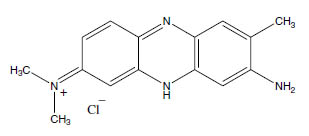
CA Index Name: 2,8-Phenazinediamine, N8,N8,3-trimethyl-, hydrochloride
Other Names: 3-Amino-7-dimethylamino-2-methyl-phenazine hydrochloride; Aminodimethylaminotoluaminozine hydrochloride; Cerven neutralni; Cerven toluyle-nova; C.I. 50040; C.I. Basic Red 5; C.I. Basic Red 5, monohydrochloride; Kernechrot; Michrome No. 226; Neutral Red; Neutral Red W; Nuclear Fast Red (basic dye); 2,8-Phenazinediamine, N8,N8,3-trimethyl-, monohydrochloride; Toluylene red
Merck Index Number: 6488
Chemical / Dye Class: Phenazine
Molecular Formula: C15H17ClN4
Molecular Weight: 288.78
Physical Form: Dark green or brownish-black powder
Solubility: Soluble in water, ethanol, ethylene glycol; practically insoluble in xylene
Melting Point: 290 °C (decompose)
pH Range: 6.8-8.0
Color Change at pH: Red (6.8) to yellow (8.0)
pKa: 6.7, 7.4
Absorption (λmax): 540 nm, 533 nm
Emission (λmax): 640 nm
Synthesis: Synthetic methods
Staining Applications: Cells; lysosomes; nuclei; nucleic acids; retina
Biological Applications: Detecting pathogens, bacterial infections; treating age-related macular degeneration, burns, cancer, diabetes, obesity, fungal infections, viral diseases
Industrial Applications: Liquid crystal displays; el cells; photovoltaic cells; solar cells; photochromic materials; sensors; thermochromic materials; detergents; wood
Safety / Toxicity: Combustion toxicity; cytotoxicity; DNA damage; lysosomal stability; genotoxicity; microbial toxicity; mutagenicity; nephrotoxicity; neurotoxicity; phototoxocity; soil toxicity
Certification / Approval: Certified by Biological Stain Commission (BSC)
 Реакции и методы исследования органических соединений. Книга 10
 Сборник составлен из монографических статей-обзоров, посвящённых наиболее ...
 Окиси олефинов и их производные
 Книга представляет собой монографию, посвящённую а-окисям олефинов и их ...
 Идентификация органических соединений
 Книга написана профессором Копенгагенского университета С. Вайбелем и посвящена ...
 Метод молекулярных орбит и реакционная способность органических молекул
 Монография посвящена применению методов квантовой химии для количественной ...