Methylene Blue
Name: Methylene Blue
CAS Registry Number: 61-73-4
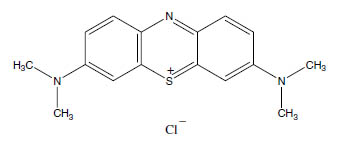
CA Index Name: Phenothiazin-5-ium, 3,7-bis(dimethy-lamino)-, chloride (1:1)
Other Names: C.I. Basic Blue 9; Phenothiazin-5-ium, 3,7-bis(dimethylamino)-, chloride; Aizen Methylene Blue BH; Aizen Methylene Blue FZ; Basic Blue 9; Basic Lake Blue; C.I. 52015; C.I. Solvent Blue 8; Calcozine Blue ZF; Chromosmon; Duasyn Basic Blue IAD; Ext D and C Blue No. 1; External Blue 1; Hidaco Methylene Blue Salt Free; Izit Crystal Dye; Leather Pure Blue HB; Maxilon Blue SG; Methylene Blue 2B; Methylene Blue 2BF; Methylene Blue 2BN; Methylene Blue 2BP; Methylene Blue A; Methylene Blue B; Methylene Blue BB; Methylene Blue BBA; Methylene Blue BD; Methylene Blue BP; Methylene Blue BPC; Methylene Blue BX; Methylene Blue BZ; Methylene Blue D; Methylene Blue FZ; Methylene Blue G; Methylene Blue GZ; Methylene Blue HGG; Methylene Blue IAD; Methylene Blue JFA; Methylene Blue MB; Methylene Blue N; Methylene Blue NF; Methylene Blue NZ; Methylene Blue SG; Methylene Blue SP; Methylene Blue ZF; Methylene Blue ZX; Methylene Blue Zinc Free; Methylene Blue chloride; Methylene Blue; Methylene Blue polychrome; Methylenium ceruleum; Methylthio-nine chloride; Methylthioninium chloride; Mitsui Methylene Blue; NSC 617593; Sandocryl Blue BRL; Schultz 1038; Solvent Blue 8; Swiss blue; Tetramethylthionine; Tetramethylthionine chloride; Urolene Blue; Yamamoto Methylene Blue B; Yamamoto Methylene Blue ZF
Merck Index Number: 6060
Chemical / Dye Class: Phenothiazine
Molecular Formula: C16H18ClN3S
Molecular Weight: 319.85
Physical Form: Green powder
Solubility: Soluble in water, ethanol, ethylene glycol, methyl cellosolve
Melting Point: 100-110 °C (decompose)
pKa: 2.6, 11.2
Absorption (λmax): 661 nm
Synthesis: Synthetic methods
Staining Applications: Blood; bone marrow; eye lens; sentinel lymph nodes; mammary tissues; nucleic acids
Biological Applications: Detecting microorganisms; treating diabetic retinopathy, macular degeneration, malignant uveal melanomas, erysipelas, hidradenitis suppurativa, inflammation, skin diseases
Industrial Applications: Thin films; inks; packaging material
Safety / Toxicity: Effluent toxicity; genotoxicity; hematotoxicity; microbial toxicity; mutagenicity; neurotoxicity; nucleic acid damage; photodynamic toxicity; reproductive toxicity; teratogenicity

 Контактно-каталитические процессы в области органических соединений и их приложение в технике
 Воспроизведено в оригинальной авторской орфографии издания 1927 года ...
 Общая технология синтетических каучуков
 В книге изложены основные сведения о современных промышленных методах ...
 Избранные труды по химии
 Издание содержит избранные работы великого голландского учёного, первого ...