DiOC7(3)
Name: DiOC7(3)
CAS Registry Number: 53213-83-5
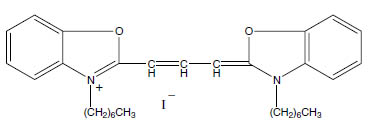
CA Index Name: Benzoxazolium, 3-heptyl-2-[3-(3-heptyl-2(3H)-benzoxazolylidene)-1-propenyl]-, iodide
Other Names: D 378; DiOC7(3)
Merck Index Number: Not listed
Chemical / Dye Class: Cyanine
Molecular Formula: C31H41IN2O2
Molecular Weight: 600.57
Physical Form: Red crystals
Solubility: Soluble in ethanol, methanol, dimethyl sulfoxide
Melting Point: 194-197 °C
Absorption (λmax): 482 nm
Emission (λmax): 504 nm
Synthesis: Synthetic method
Staining Applications: Mitochondria; cells; fungi; tumors
Biological Applications: Detecting cells, fungal stress, membrane potential; cytotoxicity assays
Industrial Applications: Not reported
Safety / Toxicity: No data available
Книги Список книг
 Allen’s commercial organic analysis
 Allen’s commercial organic analysis; a treatise on the properties, modes of assaying, and proximate analytical examination of the various organic ...
 Механизмы катализа нуклеофильных реакций производных карбоновых кислот
 В книге обобщены результаты обширных экспериментальных и теоретических ...
 Micro-chemistry of Poisons
 Micro-chemistry of poisons: including their physiological, pathological, and legal relations; with an appendix on the detection and microscopic ...
 Введение к полному изучению органической химии
 Воспроизведено в оригинальной авторской орфографии издания 1864 года ...