SPQ
Name: SPQ
CAS Registry Number: 83907-40-8
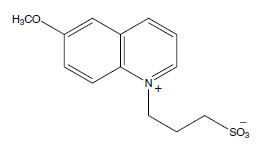
CA Index Name: Quinolinium, 6-methoxy-1-(3-sulfo-propyl)-, inner salt
Other Names: 6-Methoxy-N-(3-sulfopropyl)quinolinium, inner salt; SPQ
Merck Index Number: Not listed
Chemical / Dye Class: Quinoline
Molecular Formula: C13H15NO4S
Molecular Weight: 281.33
Physical Form: White powder
Solubility: Soluble in water, dimethyl sulfoxide
Melting Point: > 299 °C (decompose)
Absorption (λmax): 344 nm
Emission (λmax): 443 nm
Synthesis: Synthetic methods
Staining Applications: Chloride ions; nitrite ions
Biological Applications: Chloride indicator; nitrite indicator; diagnosis of diseases caused by elemental imbalances; detecting cancer cells, spores, stress biomarkers; identifying genes; studying chloride-bicarbonate exchange
Industrial Applications: Not reported
Safety / Toxicity: No data available
 Справочная литература по органической химии
 В книге разобраны наиболее важные реферативные журналы, в соответствующих ...
 Органическая химия. Углублённый курс. Том 2
 Второй том систематизированного учебного и справочного руководства по ...
 Ионная теломеризация
 Среди других методов органической химии в последнее время значительную роль стал ...
